Trixie Beaumont–Sadie relationship
It Must Be Love: A Mustang Prairie RomanceThe Trixie Beaumont–Sadie relationship is a sustaining friendship built from candor, humor, labor, and mutual belief. Sadie is not merely Trixie’s confidante; she is the person who helps Trixie interpret Jack Thorpe’s contradictory behavior, defend her emotional boundaries, and move from selling lingerie to becoming a designer. Trixie, in turn, recognizes Sadie’s artistic achievement, welcomes her into the work of the shop, and treats her success as something worth celebrating. Their bond gives the romantic plot a stabilizing counterweight: where Jack Thorpe creates uncertainty, Sadie supplies clarity, warmth, and action.
Friendship and Mutual Trust
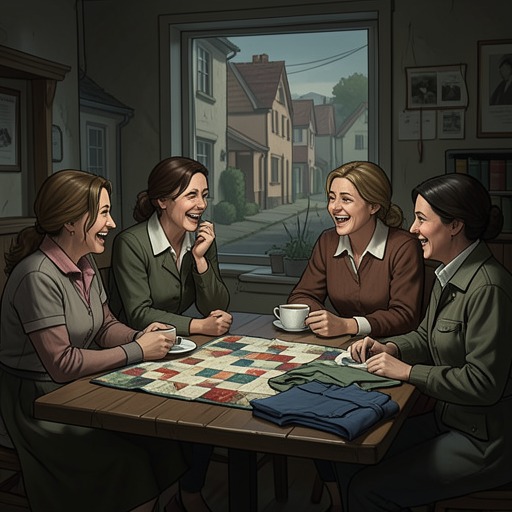
Trixie and Sadie’s closeness is established through ordinary companionship as much as through dramatic confession. When Sadie comes to the shop to help with new inventory, she explicitly says that she knows she does not have to help but has missed Trixie. The work is familiar and shared: they carry boxes into the back of the store, hang gowns, and prepare merchandise together. The scene presents friendship as practical presence rather than sentimental declaration. Sadie’s artistic ambitions have begun taking her elsewhere, yet she still returns to Trixie because affection matters more than obligation.
Trixie responds with equally personal admiration. After seeing a video of Sadie performing with a tattooed rocker, she tells Sadie that the performance was hot and admits that she was so proud of her friend that she cried. Her reaction does not contain competitiveness or resentment. Sadie’s success enlarges Trixie’s sense of what is possible, while Trixie’s pride confirms that Sadie’s new public identity has not displaced the intimacy of their private friendship.
The friendship also functions as a social welcome. Trixie brings Honey to Hump Day Hooch and explains that making Mustang Prairie home means making friends. The gatherings involve talking, drinking, catching up, and absorbing newcomers into an established circle. Sadie’s home becomes one of the places where Trixie can bring people together, and Sadie’s wider network helps turn Trixie’s personal attachment to the town into belonging within a community.
Emotional Protection and Romantic Counsel
Sadie is Trixie’s principal emotional witness during the conflict with Jack. After Jack discovers Abby Thorpe in Trixie’s store and angrily confronts Trixie, Trixie arrives at a gathering already braced for judgment. Shirl gives her a margarita, but Sadie provides the deeper reassurance, apologizing for ambushing her and insisting that Jack is a good man, just as Trixie herself had once said. Trixie answers that she will keep her distance from Jack and, if necessary, from Abby as well. Sadie’s embrace makes clear that the friendship remains intact even when Trixie is trying to withdraw from the Thorpe family.
Sadie is also willing to say what Trixie does not want to hear. She reports that Dylan has noticed the chemistry between Trixie and Jack, and later tells Trixie that the sparks between them are so obvious that they drove her to seek out Dylan. At Hump Day Hooch, when Trixie insists that she and Jack are only friends, Sadie rejects the claim rather than politely accepting it. Her teasing is affectionate, but it serves a serious purpose: she prevents Trixie from disguising mutual desire as ordinary neighborliness.
After Jack and Trixie sleep together, Sadie becomes more protective, not less. She pours Halloween-tinis, listens to Trixie describe Jack’s hurtful response, and refuses to excuse his failure to explain his intentions beforehand. Her criticism distinguishes sexual desire from emotional fairness. She can acknowledge that Jack may be a good man while still arguing that a good man should have told Trixie what he wanted before they became naked and vulnerable. This is one of the friendship’s defining qualities: Sadie does not confuse loyalty with agreement, and she does not let Trixie’s long love for Jack make disappointment seem acceptable.
Sadie likewise reads small gestures as evidence. When Jack sends Trixie her preferred Hippie Dippie breakfast from The Stick Shift, consisting of an egg-white omelet with alfalfa sprouts and spinach, goat cheese, shredded sweet potatoes, and turkey sausage, Sadie treats the order as proof that his interest extends beyond a casual sexual impulse. Trixie remains cautious because she has loved Jack for too long to approach him casually and fears that he will not return that love. Sadie urges her to recognize that he wants all of her, not merely sex. The contrast between Trixie’s guarded interpretation and Sadie’s confident reading gives their conversations both comic energy and emotional precision.
Support for Trixie’s Entrepreneurial Work
Sadie’s support extends directly into Trixie’s professional life. When Trixie shows her the logo for her developing line, Sadie immediately praises it as fun, flirty, and sexy. Trixie then explains that she has established a basic website and plans to refine it with online ordering, perhaps adding a special area called Trixie’s Corner. The exchange allows Trixie to speak about her enterprise not as a fantasy but as an active project. She compares the feeling to Sadie’s experience of receiving a record deal, recognizing that both women have crossed from private aspiration into public work.
Their friendship therefore links emotional encouragement with concrete business development. Trixie has spent months considering a clothing line, experimenting with names, sketching logos, and contacting a graphic designer, but the preparations have begun to taunt her because she has not acted. Sadie’s attention helps give the stalled dream an audience. Trixie decides that she will begin that night, even while unable to walk around officially because of her injury. Sadie’s belief does not replace labor; it helps Trixie commit to it.
Trixie’s first line, Sexy Separates by Trixie, grows from this movement toward self-definition. She imagines six to ten panty styles, from g-strings and bikinis to French cuts, using silk, lace, and cotton, with a possible boy-cut option. A rainbow palette will accommodate vibrant colors, while several bra styles, including a convertible bra, will let customers mix and match rather than purchase only conventional matching sets. Sadie’s habit of mismatching lingerie because she likes the colors together becomes part of the practical logic behind the brand. The friendship thus contributes not only morale but market insight: Trixie observes Sadie’s preferences and turns them into a design principle.
Sadie’s support remains present as the line develops. Trixie describes the first collection as Sensual Separates, emphasizing pieces that can be mixed and matched, including combinations built around favorite team colors. Jack notices Trixie’s entrepreneurial determination, but Sadie has already helped her articulate it. The business becomes a form of independence rooted in pleasure and choice, and Sadie is among the first people to treat that ambition as serious work rather than decorative self-indulgence.
Shared Community and Public Success
The relationship reaches its most visible expression at the launch of Trixie’s line. At Dylan’s bar, the space is transformed into a makeshift runway, with gauzy fabric, lighting, music, and a bedroom-like atmosphere. Sadie and the other models wear Trixie’s designs, including teal boy shorts with a matching Basque, a white cheeky set with a bra and silky duster, and cherry-red stilettos. Several of Sadie’s and Kiki Ramirez’s songs provide the soundtrack. Sadie is therefore both friend and collaborator: she lends her performance presence, her body, and her public visibility to Trixie’s new enterprise.
Trixie watches from backstage as the show gathers force. Sadie’s movement, smile, and ability to flirt with the entire room make the clothes vivid in public rather than merely attractive in private. When the cameras flash and the bar erupts in applause, Trixie recognizes the moment as the image that could launch the line. The show succeeds because the friendship has crossed into collective production: Sadie’s performance, the models’ participation, and the community’s attention turn Trixie’s sketches into a public brand.
After the models congratulate her, Trixie walks the runway holding Sadie’s hand. The gesture compresses the emotional history of the enterprise into a visible image of solidarity. Trixie feels satisfied because the line has officially launched and the show has worked, yet the success is shadowed by loneliness: she has achieved something extraordinary and feels she has no one to share it with, not really. Sadie’s presence cannot erase Trixie’s unresolved feelings for Jack, but it demonstrates that Trixie is not actually alone. Her friend has helped make the achievement possible and stands beside her at its public culmination.
Narrative Significance
The Trixie Beaumont–Sadie relationship gives the novel a model of intimacy that is neither romantic nor passive. Sadie offers physical comfort, comic provocation, practical labor, professional collaboration, and moral judgment. She can hug Trixie after the confrontation with Jack, threaten to smash his beautiful face, celebrate Trixie’s logo, help unpack inventory, and perform in the launch show. These actions make care tangible. Friendship appears as a repeated willingness to spend time, risk inconvenience, tell the truth, and show up at the decisive moment.
Their bond also protects Trixie’s autonomy. Sadie recognizes Trixie’s attraction to Jack without allowing that attraction to define her worth. She encourages Trixie to claim the evidence of Jack’s interest, but she also condemns his emotional evasiveness. At the same time, she supports Trixie’s business as an independent source of identity and stability. Trixie’s movement toward lingerie design is consequently not isolated self-invention; it is enabled by a network in which Sadie supplies both intimate knowledge and public partnership.
Within the romantic-comedy structure, Sadie serves as confidante, truth-teller, and community bridge. She exposes the gap between Trixie’s denials and the visible chemistry with Jack, challenges the excuses surrounding their sexual relationship, and helps sustain Trixie through avoidance, embarrassment, and professional triumph. The friendship’s decisive achievement is not simply that Sadie comforts Trixie. It is that she helps Trixie remain legible to herself: a woman capable of desire, anger, ambition, friendship, and success even when Jack Thorpe cannot yet offer her certainty.